Chess Rules Cheat Sheet: One-Page Printable Guide
 Play Chess
This chess rules cheat sheet fits every rule a beginner needs into four short tables: the starting position, how each piece moves, the special moves, and the ways a game ends. Print it, keep it next to the board, and you can settle almost any argument in seconds.
The starting position
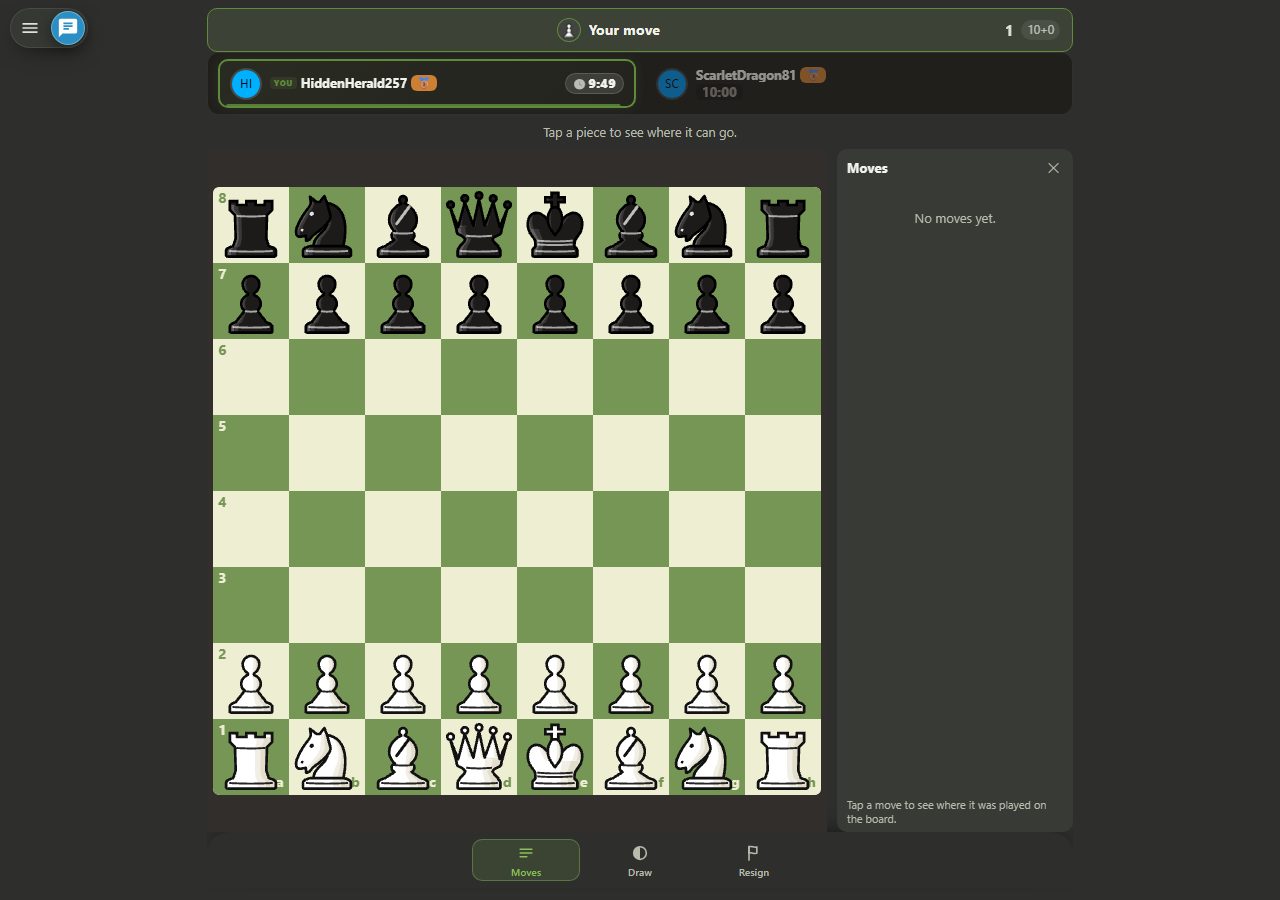
The board is 8×8 and White always moves first. The screenshot shows the board before move one, with White at the bottom.
| Rank | What stands there |
|---|---|
| 1 (White) | R N B Q K B N R, file a to h |
| 2 (White) | Eight pawns |
| 3 to 6 | Empty |
| 7 (Black) | Eight pawns |
| 8 (Black) | R N B Q K B N R, mirroring White |
How each piece moves
The last column is the usual value used to judge trades. It is a counting aid, not a rule: the game never forces you to follow it.
| Piece | Moves | Captures | Value |
|---|---|---|---|
| King | 1 square, any direction | Same as it moves | Protect it |
| Queen | Any distance: straight or diagonal | Same as it moves | 9 |
| Rook | Any distance: along a rank or file | Same as it moves | 5 |
| Bishop | Any distance: diagonal | Same as it moves | 3 |
| Knight | L-shape: 2 squares one way, 1 across; jumps over pieces | Same as it moves | 3 |
| Pawn | 1 forward; 2 forward from its start rank if both squares are empty | 1 square diagonally forward | 1 |
Everything except the knight is blocked by pieces in its path. A pawn never moves backward and cannot capture the piece standing straight in front of it. For deeper explanations see chess pieces and how they move.
The special moves
| Move | The rule |
|---|---|
| Castling: pieces | King and that rook have never moved, and the rook was not captured at home |
| Castling: squares | Squares between them are empty: f and g kingside; b, c and d queenside |
| Castling: safety | The king is not in check, and does not pass over or land on an attacked square |
| Castling: notation | O-O kingside, O-O-O queenside |
| En passant: when | An enemy pawn has just advanced two squares and stands beside yours |
| En passant: how | Capture it diagonally, as if it had moved one square; only on the very next move |
| Promotion | A pawn reaching the last rank must become a queen, rook, bishop or knight; by pushing or by capturing |
Pawn details live in chess pawn rules. A move that leaves your own king attacked is never allowed, which is why a pinned piece cannot leave its line and why you must answer every check. In this game a picker lets you choose the promotion piece.
How a game ends
| Ending | Result | Condition |
|---|---|---|
| Checkmate | Win for the mating side | No legal move and the king is in check |
| Resignation | Win for the other side | A player resigns; it cannot be undone |
| Time out | Win for the side with time left | Your clock hits zero and your opponent could still mate |
| Time out, no mate possible | Draw | Your clock hits zero but your opponent cannot possibly mate |
| Stalemate | Draw | No legal move and the king is not in check |
| Threefold repetition | Draw | Same position three times (same side to move, castling and en passant options); automatic here |
| Fifty-move rule | Draw | 100 half-moves with no capture and no pawn move; automatic here |
| Insufficient material | Draw | K v K; K+N v K; K+B v K; K+B v K+B with bishops on the same colour |
| Agreement | Draw | One side offers, the other accepts |
If a position is both mate and the fifty-move limit, the mate wins. A draw offer stands until it is answered or until anyone plays a move, so simply moving declines it. More on each case in chess draw rules and stalemate.
Download the printable version
Want it on paper? Here is the printable chess rules (PDF): the tables above on one page.
How to read the sheet
Start with the pieces table, then the special moves, because those are the rules beginners forget most. Keep the endings table handy for the moment a game looks strange: a king that cannot move is not always mated, and only the check decides between a win and a stalemate draw.
Moves are written in standard algebraic notation with English letters K, Q, R, B and N, and no letter for pawns. A capture adds x, a check adds + and a mate adds #, so Qxf7# is a queen capturing on f7 with checkmate. The notation guide is chess notation explained. Games here use a whole-game clock with seven choices: 1+0, 2+1, 3+2, 5+0, 10+0 (the default), 15+10 and 30+0, where the second number is seconds added after each move. See chess time controls.
Where to go next
The fastest way to learn the rules is to use them. Press the Play button above for a game against the computer, where legal squares are marked with dots and a king in check glows red, so the sheet is a backup rather than a test. For a full walkthrough read how to play chess, and for a gentler start try playing chess against the computer. You can also open chess directly.
Keep the sheet beside you for your first few games; when you stop reaching for it, you know the rules.
Frequently Asked Questions
What are the basic rules of chess?
Two players move one piece per turn, White first, on an 8×8 board. Each piece moves in its own way, and you win by checkmating the enemy king: attacking it so it has no legal escape. The tables above list how each piece moves and how a game ends.
Is there a printable chess rules PDF?
Yes. The link in this post opens a one-page PDF made from the tables on this page: the starting position, piece moves, special moves and endings. Print it and keep it beside the board.
What are the conditions for castling?
The king and that rook must not have moved, and the rook must not have been captured. The squares between them must be empty, the king cannot be in check, and it cannot pass over or land on an attacked square.
How long can I take to capture en passant?
Only one move. The chance appears right after an enemy pawn advances two squares to stand beside yours, and it disappears if you play any other move first.
How does a chess game end in a draw?
By stalemate, threefold repetition, the fifty-move rule (100 half-moves without a capture or pawn move), insufficient material, agreement, or a time-out when the opponent cannot possibly mate. Here, repetition and the fifty-move rule apply automatically.
What are the standard piece values?
Pawn 1, knight 3, bishop 3, rook 5, queen 9. They are a guide for judging trades, not a rule of the game, and the king has no value because you must never lose it.